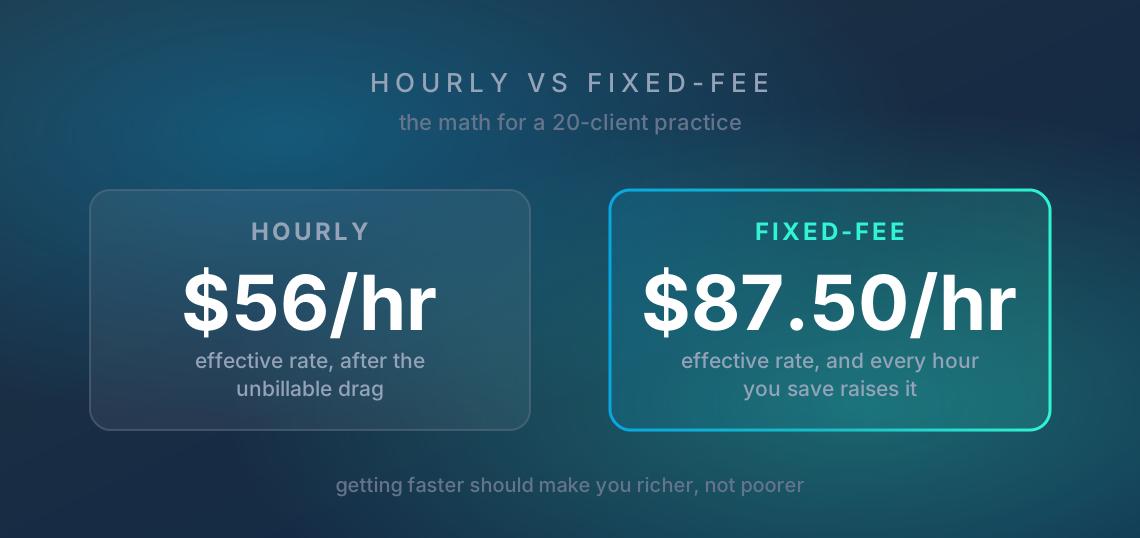
For a 20-client practice, hourly billing at $75 an hour looks like $9,000 a month until you count the unbillable hours, which drag your real rate down to about $56 an hour. Fixed-fee billing at $350 a client looks like less ($7,000 a month), but if automation cuts delivery to about 80 hours, your effective rate climbs to roughly $87.50 an hour and you keep every hour you save. The model that wins is the one where getting faster makes you richer, not poorer.
The hourly math, honestly run
Take a solo practice with 20 monthly clients. A typical small-business client needs around 5 to 7 hours of bookkeeping a month: statements in, categorization, reconciliation, a review pass, and the back-and-forth. Call it 6 hours per client on average. That is 120 billable hours a month.
At $75 an hour (a common Canadian bookkeeping rate, and squarely in the US range for experienced independents), that is 120 x $75 = $9,000 a month, or $108,000 a year. Clean math. It is also not what you earn per hour of your life, because those 120 hours are not your whole month. Document chasing, admin, proposals that go nowhere, the tech setup that eats a Tuesday: in our experience 20 to 30 percent of an independent bookkeeper's month is unbillable. On a 160-hour month, that is 40 hours you work for free.
So the honest number is $9,000 divided by 160 hours, which is $56.25 an hour. Your rate card says $75. Your life says $56. Make every pricing decision on the second number, not the first.
The trap built into hourly
Here is the part nobody frames correctly: under hourly billing, every efficiency gain is a pay cut. You automate statement entry and save 10 hours a month. Congratulations, you just lost $750 a month. That is not a theory, it is the arithmetic of the model: income equals hours times rate, so any hour you eliminate is income you destroy. The rational move under hourly billing is to work at a comfortable pace and never fix anything slow. The model rewards inefficiency and punishes the exact improvements that would make your practice better.
It also caps your upside. You have 160 hours in a month and no more. To grow, you add clients, which adds hours, which gets you closer to the ceiling, which forces you to hire, which turns you into a manager of other people's hours. Hourly billing does not scale. It just repeats.
The fixed-fee math for the same 20 clients
Now price the same 20 clients on a fixed monthly fee. Small-business monthly bookkeeping packages typically run $250 to $500 a month in Canada and the US, depending on volume and complexity. Use $350 as the middle.
20 clients × $350 = $7,000 a month. Yes, that is $2,000 less than the hourly headline. Hold the thought.
Under fixed-fee billing, your income is decoupled from your hours, so efficiency gains land in your pocket instead of your client's. The swing variable is delivery time. With the data-entry work automated, the statement loop that used to eat 15 to 20 minutes per statement shrinks to a review pass, batch processing handles categorization rules, and per-client monthly work drops from about 6 hours to about 4.
20 clients × 4 hours = 80 hours of delivery a month. $7,000 divided by 80 hours is $87.50 an hour of your time. And here is the flip: every hour you save now raises that number. Save 10 hours and you are at $100 an hour. The model rewards the improvements.
Watch your effective rate change
The whole fixed-fee argument rests on one claim: delivery hours can actually come down. Book a short demo and we will run one of your real client statements through Flowboost live. You will see exactly how many entry hours come off the month, and the $87.50 number above stops being hypothetical.
Book a Free Demo →Run it with staff costs in the picture
Fair objection: most firms reading this are not solo. Put a loaded staff cost in: say your bookkeeper costs $35 an hour all-in (wages, benefits, payroll taxes; typical for an experienced Canadian or US bookkeeper).
Hourly model: 120 delivery hours x $35 = $4,200 in staff cost against $9,000 revenue. Margin: $4,800, about 53 percent.
Fixed-fee model: 80 delivery hours x $35 = $2,800 against $7,000 revenue. Margin: $4,200, or 60 percent. The margin rate is better, and the capacity story is where it gets interesting: those 40 freed hours are roughly 10 more clients at the same fixed fee, another $3,500 a month of revenue with no new hire. That is the difference between a practice that grows by adding payroll and one that grows by adding margin.
Where the hours actually come from
None of this works if delivery hours do not actually fall, so be precise about what to attack first. In a monthly bookkeeping cycle, the single biggest time sink that requires no judgment is statement handling: waiting on documents, opening PDFs, and keying transactions into rows by hand.
The arithmetic is unforgiving. Most clients have two or three accounts, which means two or three statements a month per client. At 15 to 20 minutes a statement for the full loop, a 20-client practice spends 15 to 20 hours a month just turning PDFs into data. That is a quarter of the 80-hour fixed-fee delivery budget above, sitting in the least skilled part of the workflow, and it is the exact bottleneck that pushes month-end close into the second week of the month.
This is why the fixed-fee math and automation are one conversation, not two. The fee structure gives you the incentive to cut hours; the tooling gives you the means. Either one alone is half a strategy.
How to make the switch without blowing up
If the math convinces you, do not convert all 20 clients on Monday. The firms that make this transition cleanly do it in three moves.
First, grandfather the existing book. Leave current hourly clients where they are. Changing their billing mid-relationship creates exactly the price conversation you are trying to avoid.
Second, put every new client on fixed-fee. Price from transaction volume and account count, not from months (we worked through the volume-based method in our catch-up pricing post). New clients never knew the old model, so there is nothing to defend.
Third, write the scope cap into the agreement. The known failure mode of fixed-fee billing is the $350 client who quietly becomes a 10-hour client. The fix is a written scope cap: accounts covered, transaction volume range, and a clause that the fee is reviewed annually or when volume changes by more than about 25 percent. Fixed fee without a scope cap is just hourly billing with extra denial.
Over a year or two, natural client churn converts the book. The hourly clients leave or retire; the fixed-fee clients compound. You do not need a dramatic announcement. You need a consistent rule for new work.
The bottom line
Hourly billing sells your time and then charges you for the privilege of improving. Fixed-fee billing sells an outcome and pays you for every hour you eliminate. Run the numbers on your own book with your own rates: if your effective rate after the unbillable drag is under $60, the fee model is not a gamble. It is the math telling you what the rate card would not.
If you want to see what the delivery-hours side of that equation looks like on your own statements, book a free demo and we will run one through live. It takes about 20 minutes, and the first month is free if you move forward.